

Palantir's £330m NHS Contract To Be Extended While UK Alternative Is Sought
True or False Promise: Ministers reportedly rule out breaking the deal early, with a replacement possible in two years

Palantir's £330m contract to run the NHS Federated Data Platform is set to be extended, with ministers planning to look for a British replacement later, according to a Financial Times report.
Health Secretary Yvette Cooper had been under pressure from MPs and campaigners to cancel the deal with the US technology firm. A government review is said to have found that triggering the contract's break clause would cause too much disruption to NHS data systems. Instead, ministers intend to launch a procurement process for a UK-based supplier, which could see Palantir replaced in around two years.
The plan is expected to be approved shortly.
The platform is intended to link scattered patient records, speed up hospital discharges and improve surgery scheduling, among other aims.
 The evidence for patient benefit
The headline claims about faster treatment have come under heavy scrutiny.
* Discharge delays. NHS England has said hospitals using the platform saw a 15% fall in long-stay discharge delays. The Health Foundation think-tank found no meaningful difference in discharge delays between trusts using Palantir's tool and others. An FT analysis found the 15% claim rested on underlying data showing delays falling from hundreds of thousands to zero, which is highly unlikely, and four trusts then admitted the data contained numerous errors. The FT reportedly found irregularities in discharge data for 42% of trusts.
* Waiting lists. FOI data obtained by the campaign group Foxglove suggests a single trust, Chelsea and Westminster, accounted for 84% of the outpatient waiting-list reduction cited by NHS England across the 16 trusts using the tool. Foxglove also reported that nearly a third of trusts using the platform were performing fewer procedures than before it went live. More than 20 trusts have reportedly stopped using Palantir's waiting list tool.
* Methodology. Charles Tallack, a former head of operational research and evaluation at NHS England, said the approach exaggerated the platform's impact because it did not consider what would have happened without it. The statistics watchdog has launched a fresh investigation into NHS England's statements, and an independent evaluation is not expected until 2029. The Health and Social Care Committee has also pointed to NHS England's acknowledgement of a lack of evidence backing the claimed benefits.
The other side
NHS England says more than 110,000 extra patients have undergone procedures in operating theatres with the platform's help. City AM reported that internal NHS data indicates Palantir's discharge tool cut delays by as much as 28%, and Palantir says its software is helping to deliver additional operations and fewer discharge delays. The contract is to be reviewed ahead of February 2027, when ministers will have to weigh the competing evidence, including whether any improvements can be independently attributed to the platform. Experts also caution that waiting lists are shaped by many factors, such as staffing levels, not just one IT system.
Palantir's military and immigration work
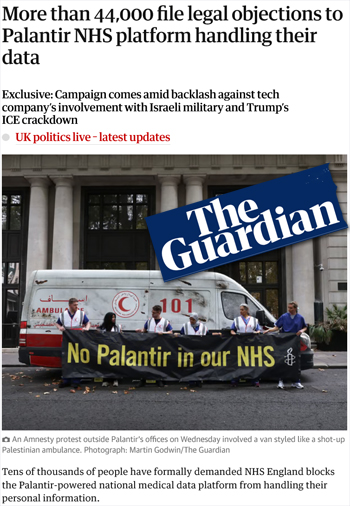
Critics of the NHS contract point to Palantir's work for the Israeli military and for US immigration enforcement.
Israel
 A UN report by Special Rapporteur Francesca Albanese said there were reasonable grounds to believe Palantir had provided Israel with predictive policing technology, core defence infrastructure for rapidly building and deploying military software, and its AI platform. The report flagged Palantir's suspected role in powering Israeli AI systems such as "Lavender" and "Where's Daddy?", which are alleged to generate battlefield targets. It found Palantir expanded its support to the Israeli military after the war on Gaza began in October 2023.
A 2025 biography of Palantir chief executive Alex Karp also alleges that Israel used Palantir software in the September 2024 pager attacks in Lebanon, which killed 42 people, and that Palantir engineers were sent to help Israeli users. Palantir has publicly responded to claims that it developed Israel's "Gospel" targeting software or is involved with "Lavender". The extent of its role in specific operations is disputed.
ICE
 In April 2025, US Immigration and Customs Enforcement (ICE) awarded Palantir a $30m contract to develop "ImmigrationOS", a surveillance platform. The contract describes the system as cutting the time and resources needed to select and apprehend immigrants according to enforcement priorities. 404 Media reported that Palantir is also developing a tool called ELITE, which maps potential deportation targets, builds dossiers on individuals and gives each a confidence score. In January 2026, ICE awarded Palantir an exclusive contract to continue running and developing its case management system. After federal agents shot and killed Minneapolis nurse Alex Pretti, Palantir staff pressed leadership over the company's ICE work.
Critics also cite the views of Palantir co-founder Peter Thiel, who has questioned democracy and said technology companies can "unilaterally change the world".
Reaction
Louis Mosley, Palantir's UK and Europe chief executive, has argued that ending the contract would put politics above patients, and has dismissed critics as suffering from "Palantir Derangement Syndrome".
Green Party leader Zack Polanski accused Labour of "betrayal", saying the decision allows the corporate capture of the NHS by a company he linked to genocide and to support for Trump. He also suggested that payments to former Labour figures, including Peter Mandelson and Tom Watson, had paid off. He said NHS staff strongly dispute the evidence of patient benefit and that many NHS trusts have rejected the platform.
Sources: Financial Times, Health Foundation, Foxglove, City AM, Digital Health, Novara Media, UN Special Rapporteur report (via Middle East Eye and The New Arab), Wired, 404 Media
